
Why Spatial Learning is Schools’ Missing Metric
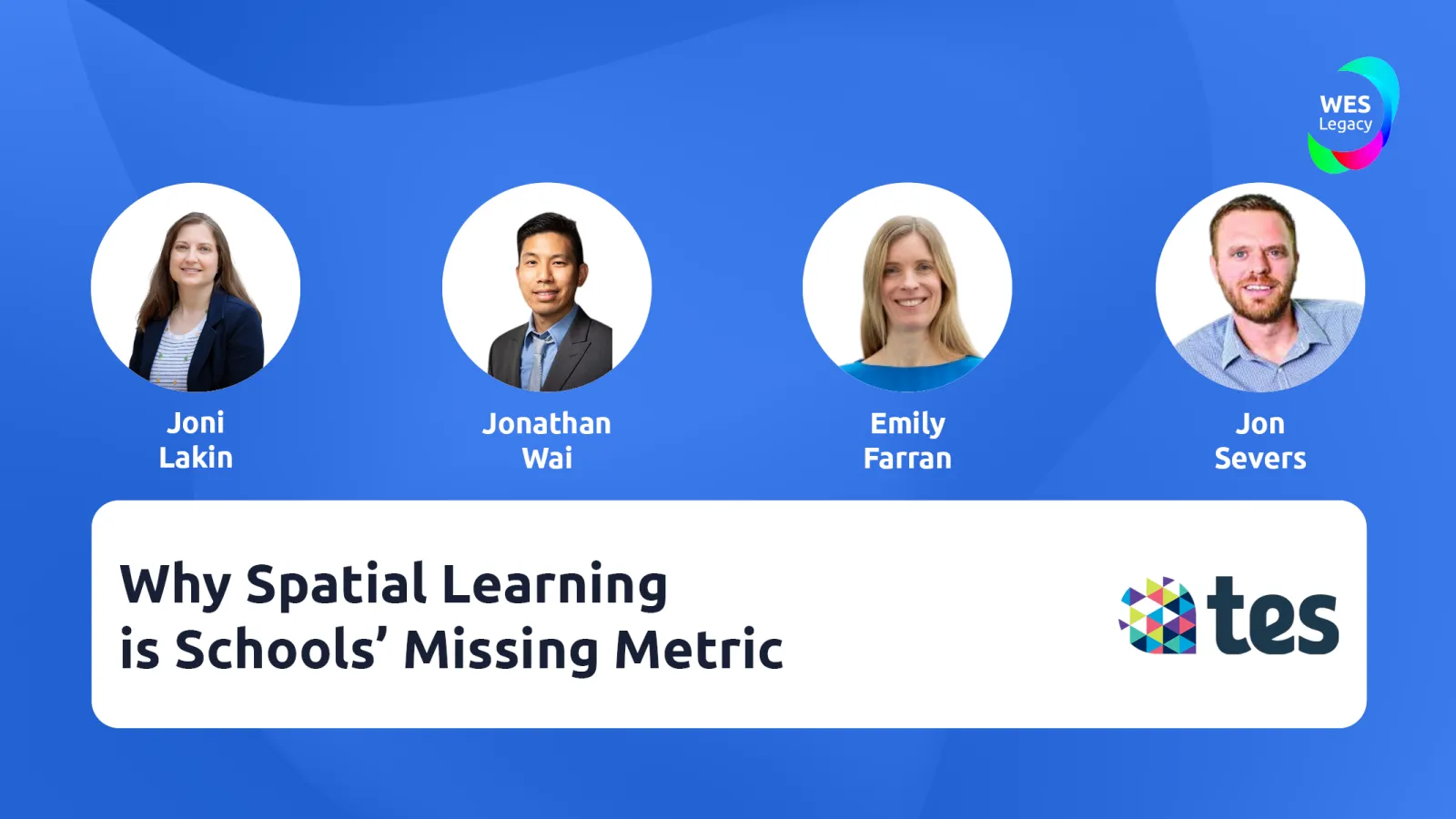
Emily Farran, Jon Severs, Jonathan Wai and Joni Lakin
Leadership & Management
Childhood Development
Curriculum Approaches
School Improvement
Keynote
WES 2022
Tes
We’re the partner to a global community of schools, leaders, and teachers, providing innovative education software products, services, content, and resources, so they can focus on enhancing students' lives through education.
 Visit Tes
Up Next

Changing Lives through Singing and Songwriting
Sophie Garner
Spatial learning and reasoning play a crucial role in education, yet they are often overlooked. The session highlights the definition and practical applications of spatial reasoning, its development in early childhood, and its correlation with academic success. It addresses the lack of field experiences in science and geography, suggesting curriculum enhancements and resources to support educators. The importance of spatial reasoning for disadvantaged children is also emphasized.Spatial ability is one of the most under-assessed skillsets in education despite it being an accurate predictor of academic success – so what is it and how can schools better assess it? In this session, three of the world’s leading academics in this field discuss what we know about spatial ability and its critical role in educational attainment They then explore how spatial ability can be better integrated into education at a system, classroom and teacher-pupil level.
No Resources found for this Session

Joni Lakin
Dr. Joni Lakin (Ph.D., The University of Iowa) is an Associate Professor of Educational Studies at the University of Alabama. She is lead author of the Cognitive Abilities Test (Form 8, U.S.) which is taken by over 2 million U.S. students each year. Her work on assessing individual differences informs educational practices by promoting talent development among marginalized communities. Her federally funded research on developing new spatial assessments seeks to engage the talents of students with potential to excel in science, technology, engineering, and mathematics (STEM) fields.

Jonathan Wai
Jonathan Wai is an Assistant Professor of Education Policy and Psychology, the 21st Century Endowed Chair in Education Policy at the University of Arkansas in the Department of Education Reform, and also holds a joint (courtesy) appointment in the Department of Psychology. He’s also held positions at Duke University and Case Western Reserve University. Broadly, Jonathan studies education policy through the lens of psychology. For more about his work go to jonathanwai.net or on Twitter @JonathanLWai.

Emily Farran
Emily Farran is Professor of Cognitive Development, at the University of Surrey, UK, where she directs the Cognition, Genes & Developmental Variability Lab. The broad aim of her _research is to characterise typical and atypical development of cognitive functions within the context of the developing _brain. Her most recent research investigates the relationship between spatial thinking and Science and Maths achievement in typically developing school-age children and in individuals with learning difficulties. Emily and her group have _worked with typical adults, individuals _with Down syndrome, Williams syndrome, Autism, Attention Deficit Hyperactivity Disorder, Cerebral Palsy and Developmental Coordination Disorder.

Jon Severs
Changing Lives through Singing and Songwriting
Sophie Garner
Helping Children Cope with Loss and Change
Amanda Seyderhelm


Developing Learning Organisations from Local to Global Perspectives
Ann Bradshaw

How Well Does Learning Endure? How Do You Know?
Alex Bedford




5 Key Challenges for International Education in the Next 5 Years
Olli-Pekka Heinonen


Tes Middle Leaders Clinic
Middle Leaders are often described as the engine room of a school. Discover strategies for building high-performing, high-trust teams. Learn from experts on creating vision, managing relationships, and leading change. Unlock your potential to inspire and drive success within your department.